MIDWEST RAIL REPORT
Volume 7, Number 2, Summer 1999
e-mail:
midwesthsr@aol.com
In This Issue:
Association Changes Name - Begins Fundraising Campaign
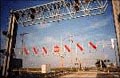
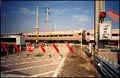
Midwest Gets $1.55 Million for Crossing Improvements
Illinois First to Commit Major High Speed Rail Funds
Georgia Plans 7-Line Atlanta Hub Network
Association Changes Name - Begins Fundraising Campaign
The Midwest High Speed Rail Association (MHSRA) has been replaced with a new organization, the Midwest High Speed Rail Coalition (MHSRC). The organization's leadership made the change so that its federal tax status will not legally restrict it from lobbying for specific high-speed rail legislation. The MHSRC then announced a $100,000 fundraising campaign to finance a comprehensive public outreach project.
"The Coalition is essentially the former Association," explained MHSRC President Dennis Minichello. "All current members of the Association will automatically be granted a free Coalition membership with the same." The new name signifies that while the Coalition shares the Association's mission, it will pursue that mission in a different way. "This is a crucial time for high-speed rail advocacy. We must be active in the public policy arena. The Coalition's tax status will now allow us to lobby public officials," said Minichello.
The MHSRA is a 501©(3) corporation, a federal designation making donations to it tax exempt for income tax purposes. This designation is useful for attracting philanthropic contributions, but also places limits on how much of an organization's resources can be expended on lobbying. The MHSRC a not-for-profit corporation without the 501©(3) designation. The MHSRC has begun a $100,000 fund-raising campaign to finance the first 18 months of an aggressive public outreach initiative, including salary for a full-time employee, travel expenses, and office start-up costs. The staffer will organize current members, involving them in meetings with elected officials, public hearings, and letter-writing campaigns. Other responsibilities include organizing lectures and conferences, developing a media presence for the Coalition, and growing the membership base.

|
|
|
|
|
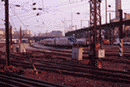
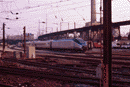
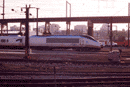
This is the second Acela trainset assembled. It was in Philadelphia this summer for testing. Click images to enlarge.
Amtrak's Northeast Corridor Improvement Project is making steady progress towards introduction of "Acela" service sometime next year. Installation of overhead electric wire catenary and support poles continues on the line from New Haven, CT through Boston. The introduction of new equipment to be used on premium express service, however, has been delayed due to problems encountered during testing.
Amtrak, meanwhile, is rolling out the biggest marketing and publicity campaign in its history, including a comprehensive effort to improve all aspects of customer service, from visiting a station, to booking a reservation, to experiencing on-board service.
"Acela is more than just a name for Amtrak's new high speed trains, Acela is a brand representing a whole new way of doing business," said Amtrak President George D. Warrington. "A combination of acceleration and excellence, Acela means high speed and high quality - we are changing the journey for every customer on every train with faster trip times, comfortable amenities and highly personalized service."
Acela will comprise three service levels: Acela Express, Acela Regional, and Acela Commuter. Acela Express, the premium service, will replace the Metroliner south of New York and constitute an entirely new service from New York to Boston. It will feature 20 new 150-mph, tilting trainsets engineered and manufactured by a consortium of Bombardier and Alstom. Acela Express will be faster than Acela Regional and Acela Commuter - traveling at up to 150 mph on segments of the New York-Boston line - and will make fewer stops. The ADA compliant Acela Express trains will accomodate 304 passengers in four Business Class cars with reserved, unassigned 2+2 seating, and one First Class car with reserved, assigned 2+1 seating. More than 30 tables will also be available throughout the train. First Class will feature video screens and at-seat food service. All cars will have large, comfortable seats with adjustable headrests, footrests, 120-volt electrical outlets, audio entertainment, large and enclosed overhead storage bins, and large windows. Bathrooms will have vanities, natural light, and changing tables, and there will be a café car in the middle of each train.
Acela Regional will replace NortheastDirect, Empire, and Keystone services and offer improved trip times and schedules, traveling up to 125 mph. Acela Regional equipment will consist of refurbished Metroliner equipment, including nearly 400 Amfleet coaches and café cars. Acela Commuter will replace the current Clocker Service between Philadelphia, New Jersey, and New York, offering upgraded equipment and improved schedules and trip times. When fully implemented, Acela Express will shorten the New York-Boston trip to 3 hours from the current 4 hours 30 minutes. The improved acceleration of the new equipment and track improvements will reduce the current Washington-New York trip to 2 hours 45 minutes from the current 3 hours. Some trains may even make that trip in just 2 hours 30 minutes. Top speed south of New York will be limited to 135 mph, 10 mph higher than the current Metroliner limit, due to its very old electric catenary. Further travel time improvements on this segment are unlikely in the near future as the necessary infrastructure improvements will require additional funding. Amtrak originally was to phase in Acela over a period of several months starting late this year when the new electric wire catenary and signal system is ready. It is not clear now how the equipment problems discovered during testing will impact this timetable.
The first schedule change will likely occur when refurbished electric Acela Regional trains shorten the New York-Boston trip to 3 hours 45 minutes by simply not having to stop to change engines in New Haven. Prior to the electrification project, passengers traveling north from New Haven had to wait while the electric locomotive was replaced with a diesel engine. The new Acela Express trainsets will begin replacing Metroliners one by one on the Washington-New York segment as the new equipment is delivered. Acela Express will then be expanded north of New York a few months later, providing through-service along the entire Northeast Corridor from Washington to Boston. Service frequencies will be boosted, especially during rush hour when trains will depart every 30 minutes from both ends of the corridor. In order to meet the anticipated demand, the total number of trains in New England are projected to double.
Currently, a majority of travelers choose rail over air travel between Washington and New York. Amtrak expects its market share to increase even further as it targets the regional shuttle airlines with Acela. At $130, the Acela fare between New York and Boston will be competitive with the current advance-purchase airfare, and even more economical when compared to a pricey walk-up airfare. The one-way Acela fare between Washington and New York will be $140, compared with the current $114 Metroliner fare.
click for larger view
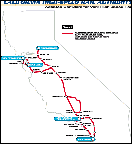
On July 21, the California High-Speed Rail Authority (HSRA) approved the mainline corridor for a 680-mile, $23 billion statewide network of high-speed passenger trains. The system would link southern California with the Bay Area and major population centers in between. The final business plan will go to the governor and legislature for approval in January, 2000, and finally to the voters by November, 2000.
HSRA is a state agency established in 1997 to study alternatives for development of a statewide high-speed rail system, draft a business plan for its operation, educate the public on its potential and formulate a financing measure. HSRA's business plan will recommend a double-track, fully grade-separated network with electric trains capable of 200 mph or greater. The Authority will also assess how feeder rail networks, some traveling at more than 100 mph, can link with and maximize access to the high-speed rail backbone.
This summer, HSRA heard from municipal officials and local agencies eager to make their priorities known regarding route and station locations. Representatives from Riverside, Temecula, the Palmdale Regional Airport, and Richmond were especially vocal in advocating routes favorable to their respective communities.
San Francisco Mayor Willie Brown and Oakland Mayor Jerry Brown also expressed eagerness to have the system serve their respective cities. "The economy of the state may ultimately depend on high-speed rail travel and not air travel," Willie Brown told the HSRA. He also said a San Francisco station should be downtown at the Transbay Terminal. "I believe you go to the population centers, as they do in Paris, France, and Japan." Los Angeles Mayor Richard Riordan, the Los Angeles City Council, the Los Angeles Board of Supervisors, and the Los Angeles Area Chamber of Commerce also support the plan. Governor Gray Davis, meanwhile, has expressed skepticism about high-speed rail in his state.
The route chosen by HSRA will have three northern forks, terminating in San Francisco, Oakland, and Sacramento. One mainline segment will link San Francisco in the vicinity of Fourth and Townsend Streets to Diridon Station in San Jose. The corridor will use the same alignment as the Caltrain service, with stations at San Francisco International Airport and Redwood City. A second mainline segment will link Oakland with San Jose. From San Jose the mainline will head east to Merced through the Pacheco Pass, with stations in Gilroy and Los Banos. The third of the northern mainline segments will link Sacramento with Merced along the State Route 99 corridor, with stations in Stockton and Modesto. From Merced, the mainline will follow State Route 99 south to Fresno, Tulare County and Bakersfield, serving downtown stations or airports if and where feasible. From Bakersfield there will be mainline service to Los Angeles Union Station along two segments, one to Palmdale, and one along the I-5 Grapevine Corridor, with stations in Santa Clarita and Burbank Airport. Three mainline segments will fork south from Los Angeles Union Station. One segment will head east to Riverside along the Union Pacific corridor, with stations in east San Gabriel Valley and Ontario Airport, and then head south from Riverside to San Diego along the I-15/I-215 Corridor, with stations at Temecula, Escondido, Mira Mesa, and Qualcomm Stadium in San Diego. The second mainline segment will head south from Los Angeles Union Station to San Diego along the existing Lossan San Diegan Corridor, with stations in Norwalk, Fullerton, Anaheim, Irvine, Oceanside, University Town Center, and downtown San Diego. The third segment will link Los Angeles Union Station and Los Angeles International Airport.
DENNIS MINICHELLO, IL
These are exciting times for high-speed rail advocates. The Midwest Regional Rail Initiative (MWRRI) continues to gain support. Illinois is prepared to spend $70 million on right-of-way improvements necessary for higher speed trains. More stories are appearing in the media favorable to this form of transportation as everyone - commuters, politicians, bureaucrats, and business leaders - realize that our existing transportation infrastructure is inadequate for the transportation needs of the 21st century. As a result of these developments, the officers and directors of this organization have been focusing on what will be needed for us to help make high-speed rail transportation a reality in the near future. It has become apparent that, as we enter a critical period for the development of high-speed rail in the Midwest, the Association will have to be involved in lobbying work.
Up until now, the Midwest High Speed Rail Association has been a 501©(3) corporation, which makes donations to it tax exempt for income tax purposes. While this designation has been useful, it comes with a severe limitation in that 501©(3) corporations are legally restricted in what they can do by way of the lobbying of public officials. After several meetings and serious discussions, the board of directors has decided that there must be a change in the structure of the organization to avoid the problems associated with its 501©(3) status.
The board has decided to create a new organization, which will be known as the Midwest High Speed Rail Coalition, a not-for-profit corporation. The Midwest High Speed Rail Coalition will not be a 501©(3) corporation. Its purpose will be to promote the development of high-speed rail in the Midwest (similar to the purpose of the Association) but will also include the active lobbying of public officials. All current members of the Association will automatically be granted a free membership in the Coalition. The officers of the Coalition will be: Dennis Minichello, President; Rick Harnish, Vice-President; Ira Silver, Treasurer; and Don Johnson-Weinberger, Secretary. The board of directors will consist of David L. Goldin, Rick Harnish, Dennis Hodges, Keith Kalinowski, Laura Kliewer, Dennis Minichello, and Nicolai Schousboe.
The Association will continue in existence and will serve as an educational and information vehicle. The officers of the Association will be Stan Miller as President and Ira Silver as Secretary-Treasurer. The board of directors will consist of Stan Miller, Jim Riley, and Bill Rogers. With the new organizational structure in place, the Midwest High Speed Rail Coalition has now begun a $100,000 fundraising campaign to finance a comprehensive public outreach initiative. This will include the hiring of a full-time staff member who will travel extensively around the Midwest, meeting with our members, organizing town meetings with elected officials, spearheading letter-writing efforts, coordinating member involvement at public hearings, and organizing and speaking at luncheons and lectures for corporate and municipal leaders. Campaign proceeds will go toward salary, travel, and start-up costs for the first 18 months of this initiative. Financial support from our members is critical to the success of this fundraising campaign. While we will also be approaching several Midwest corporations for their help, our new non-501©(3) status will prevent us from looking to other sources, including foundations. As you have no doubt noticed from the last issue of this newsletter, our membership has increased substantially over the last year. There are now over 700 individuals and organizations who share our vision - a group large enough now to have a major positive impact on our bottom line.
Your generosity is key to helping us reach our campaign goal. In addition to our $5 Basic, $25 Associate, and $100 Benefactor membership levels, we have created new categories, including $250 Advocate, $500 Patron, $1,000 Sponsor, and $5,000 Leadership Circle. All members at the $100 level and above will be recognized in every issue of the Midwest Rail Report through the end of next year.
With our ever increasing membership base and the expectation of an increase in funding, the Coalition will be able to develop and foster the grass-roots and political support necessary to achieve the goal of high-speed rail. I hope that we can count on your continued support in this new endeavor.
By LAURA KLIEWER, IL
Under Section 1010 of the Intermodal Surface Transportation Act of 1991 (ISTEA), the Secretary of Transportation designated certain rail corridors as eligible for special funds dedicated to grade crossing safety on potential high-speed rail routes. Crossing improvements could range from improved warnings to physical closure or grade separation. In the Midwest, the "Chicago Hub" was designated as a high-speed rail corridor. At that time, the Chicago Hub included rail lines from Chicago to Detroit, to Milwaukee, and to St. Louis.
ISTEA's replacement, the Transportation Efficiency Act for the 21st Century (TEA-21) added Chicago-Minneapolis to the Chicago Hub designation and dedicated at least $500,000 to this portion of the corridor. Section 1103© extends and expands the program established under Section 1010 of ISTEA. The 1998 Act also gave the Secretary authority to designate up to three additional corridors. This January, Secretary Rodney Slater announced the addition of the Chicago-Cincinnati route to the Chicago Hub. Fiscal 1999 apportionments to the eight corridors nationwide were announced July 23, 1999. Midwestern states received $1.55 million of the total $6.95 million allocated (another $15 million is authorized for this program from the general fund, but is subject to appropriations that were not made for FY 1999).
Even though it will take a much larger distribution of funds to build a high-speed rail network in the Midwest, the designation of the Chicago Hub high-speed rail corridor - with routes connecting metropolitan areas in Illinois, Michigan, Minnesota, Missouri, Ohio and Wisconsin - well-positions the region to become the next major area in the country to see high-speed rail service become a reality.
Midwest Gets $1.55 Million for Crossing Improvements
The Federal Railroad Administration has awarded financial assistance grants totaling $6.95 million to eight federally-designated high-speed rail corridors to eliminate hazards at public and private highway rail grade crossings. $1,550,000 will go to the Midwestern states, including: $500,000 to Wisconsin to upgrade four crossings between Milwaukee and Chicago with new lights, gates and constant warning time circuits, $350,000 to Illinois to upgrade two crossings and close one crossing on the Chicago-St. Louis segment, $200,000 to Indiana to support routing studies as a basis for future grade crossing investments on the Indianapolis/Cincinnati segment, $500,000 to Michigan to mitigate grade crossing hazards between Kalamazoo and Grand Beach.
All public and private highway-rail grade crossings in designated corridors are eligible for funding which may be spent on crossing closure; consolidation or grade separation; installation or upgrade of warning devices; improvements to track circuitry, crossing surfaces, crossing sight distances or illumination; installation of advanced train control or traffic control systems; and other related project development, analysis and engineering activities. The federal share of costs for improvements funded under the hazard elimination program may be up to 100 percent of the total engineering and construction costs.
Michigan
Thirteen railroad crossings in Kalamazoo County will be upgraded to decrease travel times for trains on the Chicago-Detroit corridor and improve crossing safety for motor vehicles. The $1.6 million project will commence in August and be completed by mid-November, 1999.
Ohio
The mayors of Cleveland and Columbus, as well as a number of other municipal and county officials, have co-signed a letter from Columbus Councilman Richard Sensenbrenner to Governor Taft that supports the restoration of conventional passenger rail between their two cities. Amtrak is negotiating with freight operator CSX, owner of the Cleveland-Columbus line. The service would begin no earlier than 2001. Service between Columbus and Cincinnati is also under consideration.
Wisconsin
On June 9, the Mississippi River Regional Planning Commission (MRRPC) passed a resolution in support of the Midwest Regional Rail Initiative. MRRPC is an economic development district providing assistance to local governments in nine western Wisconsin counties.
Amtrak
On May 13, mayors from throughout the U.S. gathered for the inaugural meeting of the Amtrak Mayors' Advisory Council. The mayors have come together to bolster local support for intercity passenger rail and support Amtrak's Strategic Business Plan through closer partnerships between Amtrak and cities and towns. The Council includes four mayors from the Midwest: Jim Perron of Elkhart, IN; Tom Carper of Macomb, IL; Michael Guido of Dearborn, MI; and Chuck Sanders of Waynesville, OH.
Illinois First to Commit Major High Speed Rail Funds
By KEN GOLDBERG, IL|
|
- click for larger view - |
|
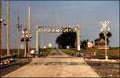
High-speed rail is now a small but official part of the State of Illinois' transportation policy. Governor George Ryan's Illinois First Plan earmarks $70 million dollars over the next five years to upgrade a major portion of the Chicago-St. Louis rail corridor for 110-mph service. The state will upgrade existing track, crossings, and signals on a 130-mile segment between Dwight and Springfield, Illinois.
"We hope to be doing 110 mph, possibly - and I say possibly - by as early as 2002, between Springfield and Dwight," said George Weber of the Illinois Department of Transportation (IDOT).
The money will be spent in equal increments over the next five fiscal years, beginning with fiscal year 2000 (which began in July 1999). Weber said that over $20 million dollars are earmarked for track and signal upgrades. Approximately $20 million will go for train sets, and another $20 million will pay for a Positive Train Control Project, a modern train control system similar to one being developed by the State of Michigan for the Chicago-Detroit corridor.
IDOT expects to reduce travel time by at least 30 minutes on the Springfield-Dwight portion of the line, with attendant ridership increases. Additional timesavings along the entire 300-mile route may eventually be achieved by some unrelated freight rail improvements in and around Chicago and St. Louis. Currently, Amtrak travel time between these cities is just over 5 hours 30 minutes.
Illinois First's efforts for 110-mph service on part of the Chicago-Springfield line is unrelated to Amtrak's new emphasis. Nor is it part of the Midwest Regional Rail Initiative, the consortium of nine states seeking passenger rail improvements. Still, upgrading rails along the Chicago-St. Louis corridor benefit the interests of each group. "We're still involved in that nine-state consortium," Weber said. "We're going to go on because we got the money approved [through Illinois First]. But we're going to continue to be a part of...that consortium. We're not going to wait for it, but it's still on the table."
Georgia Plans 7-Line Atlanta Hub Network
A plan for a $2 billion network of commuter and high-speed rail lines is gaining momentum in Georgia. Governor Roy Barnes supports rail as an integral component of the state's transporation future. The plan includes seven high-speed rail lines costing a total of $905 million. Trains traveling up to 110 mph on 790 miles of upgraded track would serve 15 stations in major metropolitan areas, including Macon, Columbus, Savannah, Albany, Jacksonville, FL, and Greenville, SC. Six commuter lines with 39 stations in 22 counties would cost an additional $550 million. A new $164 million multimodal passenger terminal to be built near Five Points in downtown Atlanta would serve as the central nexus of high-speed and commuter rail lines and would provide links with MARTA transit and buses. Funding for the rail network would come from the federal government through TEA-21 and from state matching funds.
By CLAUDE LUISADA, NM
Belgium
THALYS, the first phase of Belgium's three-phase high-speed rail system, is now carrying 48% of all passenger traffic (rail, air, and auto) between Paris and Brussels. Beginning in September there will be 21 round-trips daily between the two cities.
Canada
A high-speed rail project between Calgary and Edmonton has been revived. The $1.31 billion project would be jointly funded by Alberta Province and the private sector.
Eurostar
Eurostar Group, a joint operation of Eurostar UK, French Rail, and Belgian Rail, will assume Eurostar operations. The new entity will hopefully improve the system's financial performance. Eurostar posted an operating loss of 95 million pounds in 1998, 30% better than the 1997 loss. The service is forecast to break even by 2005.
Eurotunnel
Eurotunnel, the entity that built and operates the Channel Tunnel reported 1998 operating profits of 184 million pounds, almost four times greater than 1997 profits.
France
With funding finally in place, construction of the TGV Est is slated to begin in 2000, with service to start in 2005-6. The initial 192-mile stretch will be designed for 200-mph speeds. When the entire line is finished, TGV trains will operate between Paris-Strasbourg in 1 hour 45 minutes.
Japan
JR Central has initiated service with the new Series 700 high-speed train-set on the Tokyo-Osaka-Hakata line. Between Tokyo and Osaka the line is currently carrying an astounding 130 million passengers per year. The Series 700, a joint effort with JR West, can operate at up to 176 mph. A manned, magnetically levitated train developed by Central Japan Railway Company and Japan's Railway Technology Research Institute reached a new world speed record of 343 mph on April 14.
Netherlands
A new high-speed line between Amsterdam and the Belgian border is scheduled to open in 2005. The new line, called the Zuid line, will provide Amsterdam-Paris travel times of 3 hours and Amsterdam-London ravel times of 3 hours 45 minutes hours. The unique 62-mile line, a challenge considering the very limited clear land available, will be pile-driven and ballastless to prevent settlement problems. A 5.5 mile tunnel under the Green Heart between Amsterdam and Rotterdam is also part of the project.
Spain
Renfe has begun Madrid-Valencia high-speed service with Fiat Pendolino tilt-trains operating at 125 mph (actually broad-gauge versions of the ETR 470 Pendolino). Meanwhile more contracts have been let for the Madrid-Barcelona high-speed line, with completion of the entire project now expected by 2004.
United Kingdom
Virgin Rail has signed a contract for new equipment to equip the West Coast Line. The order is for 53 eight- and nine-car tilt train-sets capable of operating at 140 mph. The equipment is based on the Fiat Pendolino design, and will be manufactured by Alstom and Fiat Ferroviaria. First production train-sets are due in early 2001, with the entire fleet in service by May 2002.